Thursday, February 21, 2013

Product Review: Concept 2 SkiErg


I was all set to call this post SkiErg II Electric Boogaloo, but then I realized there was never an initial review.  This is a major oversight on my part as I have owned this machine for almost 2 years.  Put plainly, I have a love/hate relationship with it.  I love it because it is well made, it always works, and it uses the familiar Concept 2 PM Monitor (Mine has a PM4).  What do I hate about it?  Nothing really...aside from the fact that it is an absolute ass-kicker to the extent that an alternative working title for this post was "Hail Satan".   After further consideration, I concluded such a title would be a google-fu dog whistle for  Satan worshipers, goth teenagers, and the like.  They wouldn't like it here.

Let the record state I am not a cross country skier.  I purchased this machine because I felt that it would be a great conditioning tool that would undo a lot of the bad stuff that endless rowing might do.  In fact I still believe this to be correct.  Rowing involves a lot of legs and posterior chain, this also hits the legs to a significant extent but majorly hits the anterior chain and also involves the upper body.  This is the yin to rowing's yang or something like that.  The SkiErg can even be used sitting in a chair for example to isolate more upper body or to work around a lower extremity injury.  It is important to realize that it only simulates the double poling action in cross country skiing and a lot of people may take issue with that.  Fair enough but at the end of the day it involves all the muscles used in skiing and it delivers on the conditioning side.  The worst I have ever felt in my life was after a 1k all-out effort.  Keep in mind that I have gone to great lengths to torture myself.  Concept 2 is very good about creating online opportunities to generate H+ ions and fun in the form of online competitions both with the rower and the SkiErg.  This month the "Tour de SkiErg" is going on.  Each week is a different race which you can do any time over those 7 days.  This week is 2k, last week was 500m and the week before was 5k.  Next week is 10k.  I can't wait till next week.

For less intense aerobic efforts the SkiErg works well too.  Longer intervals are enjoyable, the machine is not loud at all so listening to music is always possible.  As far as putting the machine together, it is no big deal and the instructions are clear.  You can buy a stand for it which will allow you to move the unit around.  This costs a bit more.  I opted for the wall mounted version because I am cheap frugal.  Using the machine is pretty straightforward and I do not find it to be as technically nuanced as rowing.  Hence this a great device for intense circuit training.  Why there aren't more of these things in commercial gyms or especially Crossfit gyms I'll never know.  This seems like just what the doctor ordered for those adult daycare centers gyms.

Do I like this machine?  Put it this way, if someone told me I could only keep 2 items from my gym I'd be hanging on to my Rowperfect Indoor Sculler and my C2 SkiErg.

If the floor doesn't look like this when you are done, you didn't try hard enough.


Tuesday, February 19, 2013

On-line training: Lesson Learned and Lenten sacrifice

Anyone who followed the old Rational Fitness blog will recall my fondness for having others program my training.  I believe that if something is worth doing, it is worth doing well and therefore one should strive for optimal results.  Of course, the first ingredient is showing up.  The second ingredient is doing the right thing when you get there.  It is a lot easier for me to negotiate both of these hurdles if I know what I will be doing ahead of time.  As far as training for rowing I have worked with Xeno Muller and I have also utilized the Rojabo program.  I have done well with both.  Xeno is really good at video analysis of the stroke and also programming.  I rowed my best ever 2k race on the erg (6:36.9) while working with him.  I was 39 at the time and about 75 kg.  Being a vertically impaired (5'8") old man, I was pretty pleased with that result.  Xeno has a great website and blog and always has good informative posts.  He isn't excactly cheap but he knows the sport and he has the olympic medals to prove it.  Check out his blog here.  


I also use a Dutch website called Rojabo for my training.  To use this you run 2 tests on your erg and it will spit out a program.  It requires you to periodically redo the tests to guage your progress.  Once you do the tests, in addition to generating your next few weeks of training it will tell you your predicted result and also your potential optimal result.  Based on my last test it told me I had the potential to row 6:17.  Very flattering.  But my next question was, then why the heck did I get a 6:40.5 at my race the other week.  I am leaving oceans of time unaccounted for.  I emailed Bo from Rojabo to figure out what the deal was.  The Danish rowers are well know for having some of the fastest lightweight rowers anywhere.  Their training appears to be briefer and more intense compared to the way training is done by others.  Apparently most of these guys do other things besides rowing, they have jobs or go to school just like the rest of us.  There is no arguing with their results.  For a recent example check out Henrik Stephansen who just recently set the lightweight world record (again) on the 2k erg.  The guy goes sub 6 as a lightweight!  The scary thing is, if you check out Xeno's site, Xeno thinks there are still issues with his technique that if addressed could make him even faster!  Have a look....


Anyway in my emails with Bo I was informed that even in practice at capped rates (say a piece that calls for 20 strokes per min) these guys are always in little competitions with each other.  The program gives you a good idea where you should be at a given stroke rate so you have some parameters.  And herein lies the lesson that I perhaps have been failing to incorporate in spite of what so many people have probably been trying to tell me over the years.  If you are at a capped rate, or any rate, make every stroke count.  There should be no such thing as garbage time and I think that is where people get led astray particularly with those Concept 2 challenges where you try to log the most meters etc.  Long steady state is good but make that count too with technique drills etc.  Xeno is big on that.  If you have an interest in Rojabo, the website is www.rojabo.com.  You can try it for a month for free. 

Since it is lent and I don't want to offend the new Pope, whoever that's going to be, I have to give something up.  I am giving up wasting time with rowing garbage meters.  

Here is an interesting little aside... I repeated the power test on three different ergs (it is a 6 min test and you cover the monitor so you can't see your splits.  1 min at 20 spm x2 then 1 min each at 22, 24,26,28 spm.  Once thats done you have your splits for each of those ratings.  I tested on the c2 static, c2 dynamic and rowperfect indoor sculler.  If you set the boat in the rowperfect as a 4 and the weight at 94 kg You will in theory generate numbers almost dead on with the static c2 for the same effort.  Here are the /500 m splits all are 20-20-22-24-26-28 spm respectively.

Rowperfect:  1:51-1:51-1:49-1:47-1:44-1:40  
C2 static:  1:53-1:54-1:50-1:48-1:45-1:42
C2 dynamic 1:59-1:58-1:56-1:52-1:49-1:47

In order to convert for the rowperfect I used time splits as the monitor does not store watts in memory furthermore for any given pace the watts are higher on the rowperfect as it also accounts in its calculation for work done against the internal bungee whereas the C2 monitors do not account for this.  I used the "ultimate erg calculator" available here to make those calculations.  It is interesting that with the C2 dynamic the amount of work done at a given pace is less.  Perhaps the explanation is that is quite easy to rate higher with any dynamic machine, particularly with the Concept 2 variant because the footstretcher and handle weigh next to nothing and changing direction is almost effortless therefore maybe 23 -24 spm equates on that equates to 20 spm on the static.  You engage so instantly at the catch on the rowperfect that this does not seem to be an issue.  I suppose this is more than anyone wanted or needed to know but hopefully it is of interest to someone.

Sunday, February 17, 2013

Training music

If you spend any significant time on an erg you'll likely come to appreciate the benefit of listening to music while you train.  Since you are pretty much sitting in one place with almost no change of scenery, any external stimuli is a welcome relief.  This is in sharp contrast to rowing on the water where I strongly advocate NOT listening to music because it can be a dangerous distraction.  Anyway on the water there is the wonderful sound of oars clicking in the oarlocks, the blades moving through the water and the boat sliding through the water.  Those are great sounds.  Other not so great sounds may occur but you still need to hear them, for example: your oars slapping the water if you are rowing like shit or the sound of motorboats or douchebags on jetskis.   I have a strong dislike for that last group, can you tell?

Enough about that, this is about great songs for the erg.  Now a large list was compiled on Row2K recently and here is the link to that.  I came up with my own list and you'll see a few songs that they mentioned on Row2K but naturally my list is different better ; )

1.  "In Your Honor"  Foo Fighters --  Who doesn't like this one.  Particularly good as a warmup for a race

2.  "Paper Planes"  M.I.A.  -- Gunshots used as percussion, samples The Clash.  Its all good.

3.  "Pinpricks"  You Am I -- The best band no one in the USA has ever heard of.  I am not kidding.  Did I mention they are the best band you've never heard of?  They are that.

4.  "My Body"  Young the Giant--  "My body tells me no but I won't quit cuz I want more"  Has a more erg-appropriate song ever been written?  I think not.

5.  "Rusty Cage"  Soundgarden--  No explanation needed for this one

6.  "If You Want Blood"  AC/DC--  yeah because at the end of a hard 2k you are gonna be tasting it.   I have no idea why you taste blood after a max 2k but most people do.  Does anyone know why this is.  Pulmonary capillary congestion?  I never cough any up or anything though.  What gives?  Anyway almost anything by AC/DC is good for the erg or anything else.  If You am I is the best band you have never heard of well AC/DC is the best band you have heard of.  If you don't own all their albums I pity you.

7.  "Wolf Like Me"  TV on the Radio--  Pretty visceral and quite good

8.  "Where the Streets Have No Name"  U2--  Amazing song from an amazing album by an amazing band.  'nuff said

9."Submission"  Sex Pistols--  For a band that allegedly couldn't play their instruments this is pretty good.  Excellent choice for those lower rate higher drag pieces, which by the way you should be doing

10.  "Ain't No Right"  Jane's Addiction--  Its a song about pain tolerance.  You'll need it.

11.  "Surrender"  Cheap Trick--  Make sure its the live version from the Budokan album.  Cheap Trick is one of the few bands that sounds way better live than in the studio.  In fact for a longer steady state session you could throw the whole Budokan concert on and have an nice time.

12.  "Lit Up"  Buckcherry--  Good stuff right here

13.  "Aneurysm" Nirvana--  Make sure it is the live version from "Muddy Banks if the Wishka"  They play this one so hard that it seems like at times its gonna fall apart but it doesn't.  Kinda like the way you should feel on a hard interval.

14.  "I Turn My Camera On"  Spoon--  This is a good one.  There are so many Spoon songs that deserve honorable mention here it is ridiculous.

15.  "Jail Break"  Thin Lizzy--  One of the best bands ever.  This is a classic.

16.  "Police on my Back"  The Clash--  The thing speaks for itself

17.  "Teenage Riot"  Sonic Youth--  "You're it"

18.  "B.O.B."  Outkast--  Maybe a little fast but what a great song.  Might get you up to 40 SPM

19.  "Sweet Emotion" Aerosmith--  Phoned it in on this one cuz its a no-brainer plus there are a lot of rowers in Boston.

20.  "Till I Collapse"  Eminem--  Arguably the best erg song ever.

So there it is.  20 erg-tastic songs....Now off you go to itunes, spotify or wherever to make your playlist.

Thursday, January 31, 2013

Comprehensive Dynamic Erg Review (Rowperfect, Oartec, Concept 2)


I had originally published this article but after further analysis and time spent comparing the machines I have made some changes which I think shed more light on which of these is best.  In the way of disclosures, I have no conflicts of interest.  All machines were bought by me with my own money and none of these companies have given me anything.  When it comes to dynamic ergometers there are 3 main players presently on the market.  Concept 2 (C2), Oartec, and Rowperfect.  I should add that with respect to Rowperfect (RP) there are actually 2 different versions for sale and these are made by different entities as far as I know.  The original RP company split into two factions I guess and I'm not exactly sure how that works.  There is the Rowperfect Indoor Sculler and the RP3.  I own the Indoor Sculler and I have briefly rowed the RP3.  I'll talk about both of them.  In addition, C2 has two dynamic offerings:  The good old static machine mounted on slides and also the newer Concept 2 Dynamic.  I have both of those too.  Don't ask me how or why I ended up with all of these, I just did.  If you are in the market for such a machine perhaps I can clarify things for you.  I wish someone would have done that for me.  

It is very important when trying to evaluate things to compare them side by side, rowing something one day and then something else weeks later is sometimes the only option but it is suboptimal.  There is nowhere that I have access to where all of these machines could be tried side by side so I just made it happen in my basement.  Apparently at Rational Fitness we will stop at nothing to arrive at an answer.  Here we have the Oartec Slider, the Rowperfect Indoor Sculler, the Concept 2 dynamic and the concept 2 model C on slides in a virtual erg-mageddon.  Where is Michael Buffer when you need him?  Lets get ready to rumble.......

Let's start with the Oartec Slider which I purchased in early 2011.  This was my first dynamic machine. I reviewed this previously and I found it to be a fine machine in general.  It is definitely solidly built and has a nice smooth flow once you get going on it.  If you get out of sync at all you will bounce back and forth between the front and back stops so it rewards good technique.  The machine requires about 10 feet for use so it is not exactly small and it cannot be dismantled for storage.  The machine is designed to give about the same 500m splits as the concept 2 so splits are fairly comparable.  I always had better splits on the C2 for an equal amount of effort but they were close.   The monitor is just decent, you can set up intervals both time or distance based, you can express your effort in watts or speed and generally you can do many of the things that you can with the C2 PM3 or PM4 monitors with a few important exceptions.  There is no log card function on the Oartec.  It will only store your immediately preceding workout in memory.  In addition there is no optional pace boat to give you a visual reference to race against.  You have the option of purchasing a pickup that plugs into the monitor that will allow you to display your heart rate assuming you are wearing a Polar monitor.  This is similar to the C2 PM3 monitor in this respect.  The PM4 will wirelessly pick up any ANT+ enabled HR strap.  One problem with the Oartec monitor is that you can only display one of the following extra data options at a time (drag factor, hr, stroke length, drive ratio, strokes).  So for example, while it might be useful to see stroke length and HR at the same time, you can't do that on the Oartec.  Some of these parameters you couldn't get previously on the C2 monitor but now you can with an option which I'll get into later.  I know that at one point in time Oartec was supposed to release a PC based program to provide additional data but that hasn't happened and it has been almost 2 years since I have heard any mention of that.  I ran into a few glitches with the monitor and Oartec was very responsive regarding software updates to correct them.  Bottom line regarding the monitor is that while it is adequate, it does not measure up to the C2 monitor.  Soundwise, it is definitely louder than the Concept 2.  It is not as loud as the RP however.   Overall it feels like a heavier boat, in fact it is very very similar in feel to a concept 2 on slides.   The construction of the machine itself is solid and at the price point of $1295 USD it is a good value.  I love the orange and black color, by the way.  I ended up switching out the seat and handle for the concept 2 model D seat and handle.  This was a very inexpensive modification and I am sure more people would prefer the OEM Oartec seat and handle because both are softer, but that's just me.

Liked:
-Quality construction
-Good dynamic movement
-Attractively Priced

Didn't like:
-Monitor does not allow storage of multiple sessions
-OEM Seat and handle didn't suit me

Next we come to the Rowperfect Indoor Sculler.  This machine could and should be the best of all of them.  Given that the cost is well north of $3000 it should be nothing short of amazing.  Is it all that?  Let's see...  Here is what I like about it... It feels possibly the most like being on a single scull than any of the other ergs.  It has a built in limited tilt seat which forces the rower to keep balanced through the core.  This is great but one must keep in mind that a lot of the balancing of a shell on the water is dictated by hand height.  Still this is a cool feature.  Another nice thing is the "Oarflex" handle.  This features a built in spring in the handle that gives a bit of flex to the handle as you start the drive and theoretically places less stress on the upper extremities at that moment of highest potential force.  My battles with tennis elbow made this a major factor in my decision to get this machine. As it turns out it is not that hard to modify the Concept 2 handle to possess a similar feature.  Drop me an email and I can explain that.  The fan cage is designed so the air from the fan blows on the rower which is a welcome relief once you get going.  The design of the machine itself is pretty simple and actually quite brilliant.  It is the easiest of all of them to put together and the easiest to transport.  You could take this outside on a nice day and it would be quite easy to do.  The heaviest part is about 35 lbs and it comes apart and back together with an allen wrench.  I think the monitor is waterproof but I am not planning to test that out.  The monitor is pretty easy to use and it does some things that other monitors don't.   What do I like about the monitor?  First you can select the type of boat you are using. You can choose between a 1x, a coxless pair, a 4- and an 8.  Your results are also weight based.  So if you select an 8 for instance, your result will be what you and seven of your exact clones would row in an 8.  They say if you want results to compare with what you would pull on a C2 you just set the weight at 95kg and select a 4 person boat.  When I do that I am a bit better than I am on a C2  but you can play with the settings to get close to what you'd get on a c2 for the same effort.  The monitor comes with a HR strap and lots of options for the display including watts, stroke length, meters per stroke, total strokes, and also a cool function showing watts per heartbeat.  This last item could give a lot of good info as far as knowing how you are progressing in your fitness or maybe if you are overtraining or getting sick.  Very cool, but like many things, what is a great idea in theory gets derailed in execution.  There are some problems with this monitor.  You can't set it up for intervals.  You also can't store data.  It will only show the results of the last workout.  There is no way to interface the monitor with a computer so if there is a software update you can't get it without sending your monitor to Rowperfect either in Canada or Australia.  This can be a pain in the ass.  My first monitor got swapped out because the software version I originally got was a steaming hot mess.  The new monitor is a lot better but I still can't get it to recognize a steady heart rate; one minute it will say my HR is 150 then it will double count it to 300.  So I was looking to use watts per HR on the monitor but I really couldn't.  Of course I figured out a way around that.  I just set the monitor for avg watts and using my HR app on my iphone I can see where I am at.  The nice thing is no matter what boat type you select or weight you program, watts don't change.  This way I always know how much work I am really doing.   Also the information the monitor stores from the last session is limited in that it won't give average heart rates or watts.  I have found ways around some of these things.  I have complained to the folks at Rowperfect and they are great folks.  I was having a problem with the monitor giving erratic rates and the owner of the company walked me through repositioning the monitor pickup as it was in the wrong position.  Customer service is very responsive.  Once I corrected this the machine suddenly got a lot more pleasant to row on.  One other thing I didn't like about the machine are the footstraps.  I took them off and put on concept 2 footplates.   This is the loudest out of all the ergs but it is not an annoying sound.  You'll just have to crank up the tunes a bit louder.  The footprint of the machine is a lot smaller than the C2 static or the Oartec.  It doesn't take up much space and if you have about 7 feet or so of space you should be good to go.  This may be the ideal machine for someone who doesn't care a lot about the data collection and wants to train on perceived exertion or maybe do like I do and monitor HR with my iphone and a FISCIA key.  I like an app called "Heartworks".  It gives you nice graphs like this:  


One thing I really like about this machine is that there is nothing holding the seat like a bungee or anything.  There is a concavity in the bar that kind of keeps the seat where you want it but if you get sloppy with your technique you will know immediately. Out of all the ergs tested this feels the most like a boat, is the most pleasant to row, and provides the most feedback in terms of technique.   In summary I love this erg.  A 70 min steady state piece rowed on this machine will leave you feeling like you had a good session but not sore and irritable like I would feel after getting off the old static erg.  If I was going to do a long session it would be a no-brainer, I'd do it on this machine.   Both the C2 on slides and the Oartec feel heavy and slower by comparison.  I mentioned that another descendent from the original Rowperfect was the RP3 .  I believe these are sold here in the US now by Carlos Dinares and also by Durham Boat Company in NH.  Durham boat are nice folks to deal with and I tried their version of the RP while I was there picking up a boat.  Felt largely the same as the indoor sculler but has a different handle without the Oarflex feature.  Also it requires attachment to a computer and some software as it does not come with its own monitor.

Liked:
-feels most like being on the water in a single
-monitor allows different boats to be selected and allows rower bodyweight to factor in
-small footprint
-airflow from fan cools the rower
-oarflex handle is really nice
-amazing customer service
-very easy to transport
-solid stainless steel build

Didn't like:
-expensive
-no way to store more than 1 session data
-prefer C2 footstretcher
-heart rate pickup is dodgy


This leads us to the Concept 2 static on slides.  This has been around for quite a while and slides are simply an add-on that fits underneath the concept 2 rower.  The real drawback with these is they require a lot of space.  We are talking about 11 and a half feet of level ground.  Not everyone has that kind of space.  As far as using them goes, they feel a lot like the Oartec.  They feel like a heavier boat than the the RP. Slides run $290 per pair plus shipping from Concept 2.  If you buy a new Model D and a pair of slides it'll run you $1190-$1340 depending on whether you go with the PM3 or PM4 monitor.  The great thing about these is that if you already have a C2 and you have the space, for a little extra $ you have a dynamic option.  I picked mine up used on row2k.com.  Then if you want to train for an indoor race (which presently are all done on static machines) you can put aside the slides just before the race to get back to the feel of the static.  I put a coreperform seat on my erg to get the tilting seat feature that I have on the RP.  This works pretty well but I had to take all the hardware out of the seat and put it on loose because it wasn't tippy enough.  You can learn about coreperform here.  In summary the slides are a nice option if you already have a static and some space.  It feels like a heavier boat like I said. 

Liked:
-simple add on to the classic static concept 2 model B, C, D, or E
-better than rowing static machine

Didn't like:
-takes up lots of space
-not even remotely portable


Finally we come to the Concept 2 Dynamic.  Concept 2 was a little late to the dance with their dynamic entry but in fairness they released the slides a long time ago and probably felt that was a satisfactory dynamic option at the time.  When this erg came out there was a lot I didn't like about it.  I hadn't tried it but I didn't care for the location of the flywheel under the rower and the use of cord instead of a chain attached to the handle.  I finally got to try one a few months ago and liked it enough to get one.  My concern about the flywheel location was a non issue.  I was worried about sweat getting inside there but  the fan blows the sweat away and provides a nice cooling effect for the rower. C2 provides a plastic cover for the fan in case people don't want the fan air blowing on them but I actually like the fan.  The cord is made of something called Dyneema which is a fiber made of high molecular weight polyethylene.  This material is ultra strong.  There is a potential for wear over time and C2 includes an extra cord just in case.  My skierg uses the same material and mine has held up perfectly over the past couple years so I think this is just fine.  I think the dynamic movement of this machine is ok.  It feels more similar to rowing a single after I put on the coreperform seat.  (I still like the RP seat better than the coreperform though).  I had elevate the coreperform seat a few mm with some washers to clear the fan cage on the dynamic because of its location.  This seems to set the seat too high for me to get in a good position on the footstretcher though.  There have been some complaints about the Dynamic with some users complaining they couldn't get good connection at the start of the leg drive.  This does not seem to be a huge problem for me.  I feel the connection between the footplate and the handle and I initially felt that I had no problem suspending my bodyweight.  However, the way I think i make this happen is by opening my back too early.  I figured this out because my back would bother me after rowing on this and I couldn't figure out why.  I think there may be a bit of slop in the foot to handle connection based on the design. I really have to concentrate on not opening the back.  The machine is fairly quiet and the familiar C2 PM4 is as reliable as ever.  One thing that really differentiates the C2 dynamic from all the others that is lost on people unless they do a side by side comparison, is the absence of handle tension on the return.  There is no shock cord retracting the handle on the recovery on the C2 dynamic.  There is nothing like that on a boat either.  If you get off the dynamic and get on the RP or the C2 on slides you will feel like the handle and your hands are being pulled forward a bit on the return.  This is not boatlike.  One thing that is important in rowing on the water is getting the hands back toward the stern ASAP.  There is a tendency to want to pause at the finish.  (I was taught that "finish" is a bad word for this reason).  That is a boat stopper "GTF outta tha bow" I always tell myself.  Without the shock cord pulling you toward the catch, getting the hands out is all your responsibility.  This is good practice.  As far as actual technique, you can get away with a lot of bullshit on this machine since the seat travel is limited by a strong bungee so if you get out of kilter you won't hit the frontstops or anything.  So unlike the RP or the slides or the Oartec I don't sense a lot of punishment for poor technique.  In a sense it may almost encourage it with the tendency to make you (well at least me, anyway) want to open early with the back.  On a positive note the footprint of the dynamic is the smallest of the bunch.  At just over 6 ft, it isn't hogging up a lot of space.  Having said that, it is pretty heavy and can't easily be taken apart for storage.  The machine runs 1250 plus shipping with a PM3 monitor vs 1400 for the PM4 monitor.  I can't say enough good things about the Concept 2 monitors.  They are reliable, functional and easy to use.  Customer service is great and they are always improving their products.  Recently they came out with a free app for the iphone called Ergdata.  If you buy a special cord from C2 and a plastic holder (~$40 total) that secures your phone to the PM monitor you can have your data show up on your phone.  It is brighter than the monitor screen plus it shows tons more data that wasn't previously available unless you were running rowpro or some other computer program concurrently.  By the way, if you like Rowpro you had best stick with a C2 product because neither the Oartec nor the RP interface with it.  I personally don't care for Rowpro but that is just me.  Using Ergdata, you can now see things like peak and avg force, stroke length, drag factor, stroke count and HR all on the same screen.  You can also display speed on the PM and watts on your phone or vise versa.  You can also sync with your online logbook if you use one right from your iphone.  This is great and it seems like Concept 2 is the only one doing this sort of thing.  I like it.  

Like:
-small footprint
-uses familiar C2 monitor and Ergdata is another plus
-no tension on the cord during recovery

Didn't like
-relationship between seat and stretchers, I can't find a happy catch position
-bothers my back a little
-tiny bit sloppy at the catch (all of the above could just be me)


Conclusion:

I definitely think that dynamic is the way to go over static because I think they are easier on the body and more fun to train on.  Both those factors will foster frequent training sessions.
The ultimate question is which dynamic rower should one purchase.  The answer is it depends.  Lets look at some hypothetical scenarios.

Example 1:  An on the water rower who trains exclusively to improve for boat racing.... If this individual would find themselves needing to transport a machine frequently and had the $ then the RP would be best.

Example 2:  An athlete who cross trains and may be interested in doing some indoor competitions.  In that case a concept 2 static plus slides makes a lot of sense as long as sufficient space is available.  (Having said that I'm pretty sure you could exclusively train on a dynamic machine and jump on a static for a race and do really well or even better than you would have training on a static).  Maybe I'll try this.

Example 3:  Someone who rows for fitness and isn't interested in indoor rowing comps or maintaining an online log book .  Depending on spatial and financial constraints , the Oartec or the C2 dynamic might be a good option.

Example 4:  An individual who loves to row whilst being overly analytical and picky and has no sense of restraint.  In that case buy em all!

Battle of the Ergs


My rowing obsession started innocently enough. I bought a concept 2 from one of the guys I worked with and used it for some interval work and cardio.  Then because I had to back off the kettlebells I got a bit more serious about using the erg.  I did a few indoor rowing competitions nearby and I was hooked.  At that point I realized that because indoor rowing is a substitute for real rowing, I was essentially living in Plato's cave.  I can't seem to be able to do anything half-way when it comes to anything so early in the spring of 2011 I was off to the florida rowing center to try the real thing.  I enjoyed that and decided that it was something I wanted to do so I picked up a sculling shell and have been doing quite a bit on the water when the weather permits.  The on the water experience for me has been full of stories, adventures, and misadventures which I may go into at another time but long story short, I'm hooked on rowing.


Because I love rowing on the water I am always looking for ways to improve.  The rowing stroke is a bit like golf, there is always room for improvement.  In looking to improve there are two general areas in which improvement can occur.  These are fitness and technique.  Fitness to me is comprised of injury prevention and work capacity.  The erg adresses some of these things well and others not so much.  Ergs are great for fitness as far as work capacity goes.  You can get an excellent workout in a controlled setting and generate lots of useful data on the erg.  Injury prevention may be a different story.  Static ergs for some people are a recipe for injury, particularly involving the low back.  On a static erg the body slams into the catch position repeatedly, this involves a lot of directional changes, the force of which must be absorbed by the body.  Thus, injury risk is a concern and it is also part of the reason why more and more people are changing to dynamic ergs.  As far as technique goes, rowers like to say "ergs don't float".  This is true.  Just because you can pull a great score on the Concept 2 doesn't mean you are any good on the water.  The reason for this is because you can get away with a lot on the static erg.  The dynamic machines are designed to more closely simulate what happens on the water with the boat moving beneath the rower.  What it does not do is simulate bladework.  Bladework is a huge component to being able to move a boat.  Hence, ergs don't exactly float.  What they can do, in my opinion is develop excellent conditioning in a way that minimizes injury risk.  The dynamic ergs also to a fair extent allow the user to work on technical issues like body movement sequence and timing of the catch and drive ratios.

I talked a lot about dynamic vs static ergs in this article where I reviewed the Oartec Slider.  You may want to take a look at that and then read part II of this series because I am going to compare the Oartec Slider, the Rowperfect Indoor Sculler, the Concept 2 Dynamic and the Concept 2 static on slides.  Yeah I ended up owning all of them.  I distinctly remember saying that no way would I drop all that money on a Rowperfect.  Well I did... Was it worth it?

Wednesday, October 31, 2012

Tennis Elbow

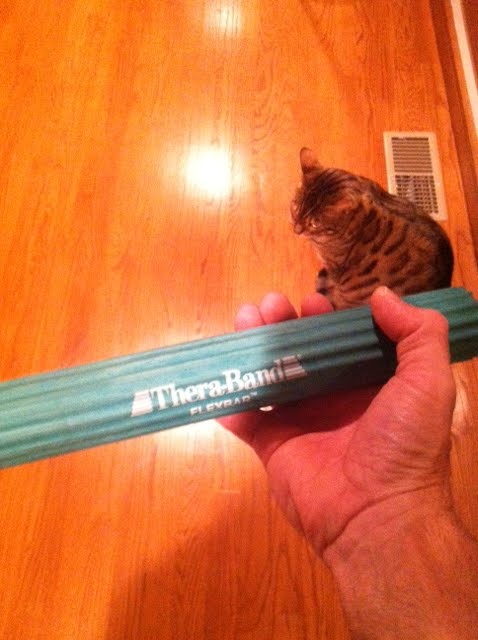
Ok. I have lots to catch up on and hopefully something really big in the next few weeks. I haven't quite completed that project just yet but when I do it'll be interesting. In the meantime, here is something that I think will be helpful to some folks. Please note that this blog does not constitute medical advice, I am merely reporting on my personal experience and what has worked for me. Your mileage may vary. Always consult your personal physician when in doubt. I don't know about you but it seems like when I hit my late thirties I started to get some of those things that I recall hearing "old people" complain about. I am referring to things like plantar fasciitis and tennis elbow. I wrote about the PF quite a bit before and I had a good result dealing with that. If you need to know more about that, hit me up via email or post a comment. Today I want to talk a bit about tennis elbow or what smarter people than me refer to as lateral epicondylitis. I don't know why exactly they call it tennis elbow. Most people who get it do not play tennis. That said, if you play tennis, there is a fairly good chance you may get it. Any repetitive motion involving the extensor muscles of the forearm can lead to it so feel free to insert your favorite masturbation joke here. I have had tennis elbow twice. The first time was a mild case a few years ago and it went away with some stretching and broomstick exercises. I developed it from too much rope climbing. The next time I developed it was much worse both in terms of severity and duration. I got it from rowing and I think it was more from rowing on the water than rowing on the erg. However, once it was present, even the erg bothered it. This really got bad in July of 2011. It kept me off the water for pretty much the rest of that summer and right about that time we moved so lots of excitement and very little rowing. I tried everything, the broomstick exercises, stretching, ultrasound, massage and I wasn't getting anywhere. After a thorough review of the medical literature I found something that looked promising. The device is called the "Theraband Flexbar". It uses eccentric strengthening to bring about a resolution to tennis elbow symptoms. My crude understanding of what goes on in this condition is that there is chronic injury to the tendons of the extensor muscles in the forearm. It is more of a tendinopathy than a tendinitis meaning that the tendon is not repairing itself correctly and tissue is not being repaired in the proper orientation. The eccentric loading of these tissues encourages the proper repair so that the pathological process is interrupted. The flexbar costs less than $30 and can be found on amazon.com or local PT supply stores may have them. The corrective exercise is called the "Tyler Twist"  . Here is a link to the article . The goal is to work up to 3 sets of 15 reps. I used a green bar. The red one is too flimsy and the blue one is too stiff for most folks. The green seems to work fine for the majority of active people. It is important to stick with this because it will not work overnight but in most cases improvement is seen within a few days.

Saturday, October 20, 2012

Don't Call it a Comeback...

I'm not sure if it is one or isn't. I announced to my wife that I was going to fire up the blog again and she said "you mean the kettlebell blog?'. I had to stop for a second because I don't have any other blog but I hadn't realized it was pretty much entirely devoted to kettlebells. For the past year and a half at least, my kettlebells have been collecting dust. I have still been training but just using other stuff like barbells, bodyweight drills, rowing (both on the erg and on the water), and running. This past summer I spent rowing on the water and training for a marathon which I ran in September. I suppose I have a lot of catching up to do on this blog if I am going to resurrect it. I do think it may be a worthwhile endeavor because I learnt a few things along the way and some readers (If I still have any) might find some useful info to help their own training. I really took a big vacation from kettlebells over the past couple years and I'd like to spend some time on that subject. While training for Ken Whethem's amazing Outlaw Kettlebell meet in May of 2011 I noticed significant pain and swelling where the body of the bell would rest on my left wrist. It got to the point where it would hurt to even touch it lightly. After the meet I completely gave up kettlebells and focused on rowing instead. The swelling persisted despite the kettlebell boycott. I showed it to a friend who is an orthopaedic surgeon and he thought it might be intersection syndrome from rowing but I told him rowing didn't bother it (although it did give me a wicked case of tennis elbow but thats another story). Eventually we just decided to stick a needle in it and a bunch of old blood came out. I probably bled into the tendon sheath and it just sat there. In spite of draining the fluid the area remains sensitive even now and the lightest kettlebells will bother it. I tried several different wrist guards and improvised ones like small shin guards under socks, I melted some pvc pipe to shape a guard but nothing worked well for me. The guards would shift too much under the bell and slide all over my arm. I really thought I had exhausted my options until I found this. This is an Evoshield wrist guard. I found this at Dick's Sporting Goods. You simply open the sealed bag that holds the insert, slide it into the neoprene sleeve, put it on, leave it on for about 30 min while it hardens in the shape of your wrist and you are all set. It doesn't slide around and it holds up well. It stood up to bells as heavy as 40 kg used for cleans and long cycle so it seems durable. This isn't cheap though. One of these will set you back about $25 but for me it is well worth it to be able to get back to doing long cycle which is the the duck's nuts when it comes to exercise. If your wrists are bothering you from kettlebells you might want to give this a try. In any case I plan on getting back into some long cycle and possibly doing more with this blog.